

View on Amazon


Introduction: Celebrating Fashion’s Most Glorious Failures
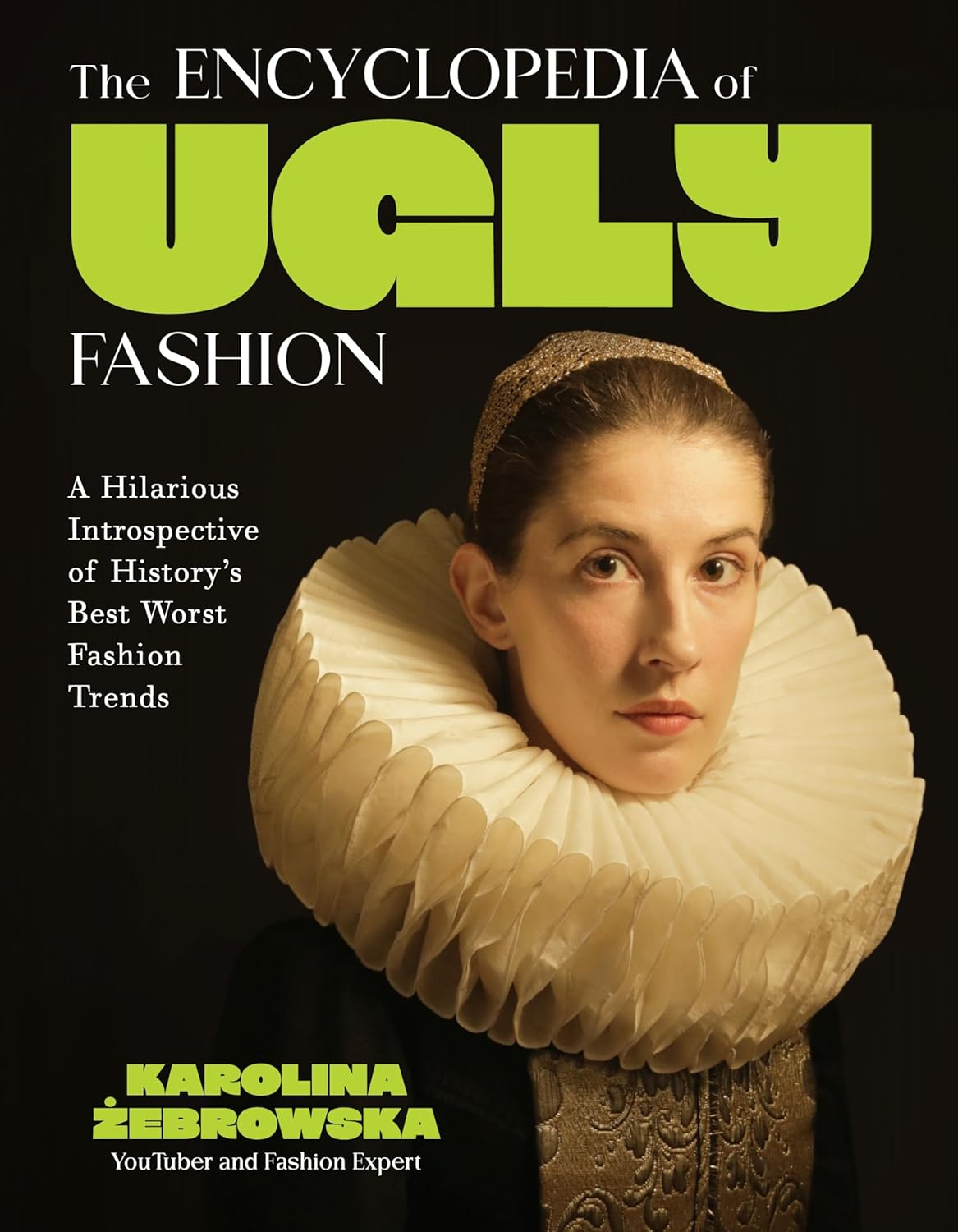
Fashion history is often presented as a linear progression of elegance and innovation, a curated gallery of iconic designs and timeless silhouettes. But this polished narrative overlooks a far more entertaining and perhaps more honest truth: fashion has always been a little bit ridiculous. For every impeccably tailored suit, there exists a 16th-century German hat shaped like a dinner plate. For every revolutionary little black dress, there is a 1950s bullet bra that defies both physics and practicality. It is this wonderfully weird, wonderfully human side of style that takes center stage in a new and utterly delightful book. “The Encyclopedia of Ugly Fashion” is not a dry academic treatise; it is a hilarious, heartfelt, and surprisingly insightful romp through the annals of history’s most magnificent fashion failures. With the wit and wisdom of fashion historian and beloved YouTuber Karolina Żebrowska, this book invites readers to revel in the bad decisions of the past, offering a fresh and funny perspective on the clothes our ancestors actually wore—and the trends they somehow thought were a good idea.
The Author: The Perfect Guide for This Sartorial Journey
The success of a book like this hinges entirely on its author’s voice, and in Karolina Żebrowska, it has found the perfect guide. Żebrowska is not a detached academic writing from an ivory tower; she is a vintage curator, fashion history connoisseur, director, actor, and a wildly popular YouTuber with a dedicated global following . Known for her sharp wit, deep knowledge, and engaging on-screen presence, she has built a career on making fashion history accessible, entertaining, and often, laugh-out-loud funny. In “The Encyclopedia of Ugly Fashion,” her unique voice translates perfectly to the page. She brings her “archival, curator lens” to each trend, analyzing not just what people wore, but the cultural context behind it and, most importantly, theorizing how it all went so horribly wrong . Her approach is a masterful blend of thoughtfulness and humor, treating each historical “blunder” with the respect it deserves while never missing an opportunity for an acerbic quip .
First Impressions: A Beautifully Produced Hardcover
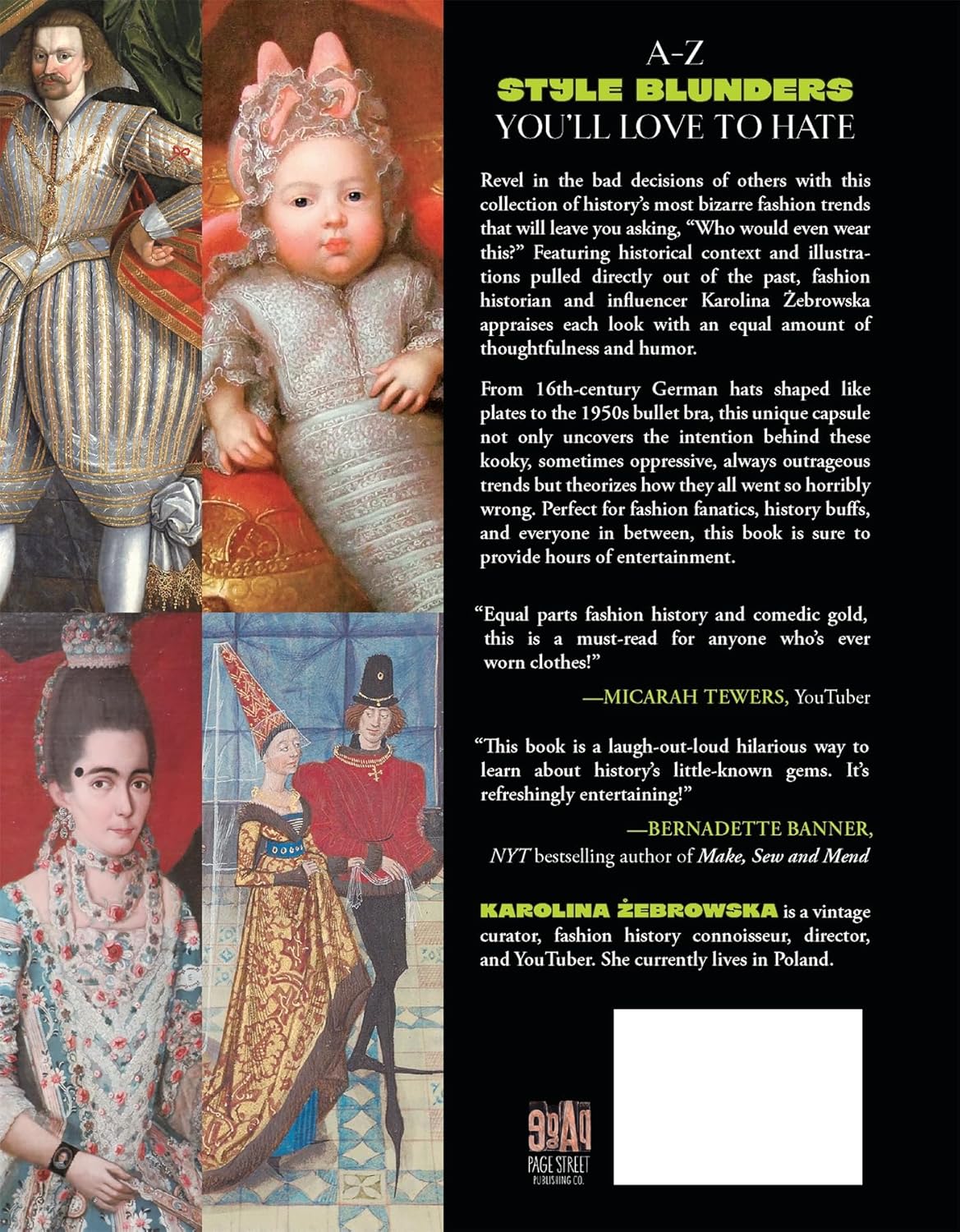
The book itself is a physical object designed to be cherished. Published by Page Street Publishing, it is a high-quality hardcover, a format that suits its role as both a coffee table conversation starter and a book to be read cover-to-cover . It spans 192 pages and measures approximately 7.25 x 9.25 inches, a comfortable size for displaying its wealth of illustrations . The cover and internal pages are filled with a treasure trove of public-domain images and caricatures pulled directly from the past . These are not modern recreations but authentic historical illustrations, including satirical articles, fashion magazine plates, and poems from the very eras being discussed . This commitment to primary sources adds an invaluable layer of authenticity, proving that people at the time were often just as aware of the absurdity of their own trends as we are today.
An A-Z of Style Blunders: What’s Inside
The book is structured as an A-Z compendium of fashion faux pas, a format that makes it perfect for dipping in and out of or for a continuous, chaotic journey through the centuries . The entries span a vast timeline, from the 14th century to the 1980s, with a particular focus on European fashion from the 16th to the 19th centuries .
Readers will encounter a rogue’s gallery of historical garments and accessories, including:
-
Liripipe Hoods: Those absurdly long-tailed hoods worn as status symbols in the 14th and 15th centuries.
-
16th-Century German Hats: As described in the book’s subtitle, hats shaped like plates that seem to defy both gravity and good sense .
-
Calash Bonnets: Large, collapsible bonnets from the 18th century, designed to protect towering hairstyles, which Żebrowska describes with her characteristic wit.
-
18th-Century Dresses: The wide panniers and restrictive silhouettes that “ruined” the natural form .
-
Venetian Stilts: Chopines, the impossibly high platform shoes worn in Renaissance Venice.
-
Sock Garters: A small but puzzling accessory from days gone by .
-
The 1950s Bullet Bra: A mid-century undergarment that took the concept of support to a conical extreme .
Each entry is brought to life with historical context interwoven with Żebrowska’s comedic quips, making for an informative and side-splittingly funny read.
The Balancing Act: Humor vs. History
The central challenge of a book like this is balancing its comedic mission with its educational one. Reviews from early readers on Goodreads suggest that this balance is precisely where the book generates the most discussion . For many, it hits the sweet spot perfectly. One reviewer describes it as “informative while also being stupidly funny,” a perfect companion for fans of Żebrowska’s YouTube channel . Another calls it a “playful take on history’s worst trends,” ideal as a gift book . The inclusion of a properly notated bibliography has also been praised, adding scholarly heft to a “pop type book” .
However, some readers felt the humor occasionally overshadowed the history. Several reviews note the heavy use of contemporary slang and “memespeak”—words and phrases like “iconic,” “it’s giving,” and “what are those”—that, while authentic to Żebrowska’s online persona, may date the book quickly . One critic felt there was “too little actual history” and that the book relied too heavily on “bad and unfunny jokes” and incoherent pop culture analogies . Another wished for a more serious approach, finding that the quips, while humorous, lacked meaningful analysis . A recurring critique is the book’s organization, with chapters grouped thematically rather than chronologically, which some found messy and made it difficult to track the evolution of trends over time .
Critical Acclaim and Audience Reception
Despite these mixed reader reactions, the book has garnered enthusiastic endorsements from prominent figures in the historical fashion and making communities. Bernadette Banner, New York Times bestselling author of “Make, Sew and Mend,” calls it “a laugh-out-loud hilarious way to learn about history’s little-known gems” and “refreshingly entertaining” . YouTuber Micarah Tewers describes it as “equal parts fashion history and comedic gold” . Historical tailor Zack Pinsent praises it for beautifully capturing “the monstrosities of fashion history,” proving that “bad taste is universal and timeless” .
These endorsements speak to the book’s core appeal: it is a love letter to fashion history written by and for enthusiasts who appreciate the quirks and oddities of the craft. It is not intended to be a definitive textbook, but a celebration of fashion’s more whimsical side.
Who Is This Book For?
The book’s target audience is broad but well-defined. It is perfect for:
-
Fashion Fanatics: Anyone obsessed with clothing history will find a treasure trove of obscure and wonderful information .
-
History Buffs: It offers a unique, accessible, and entertaining entry point into social history through the lens of what people wore .
-
Fans of Karolina Żebrowska: For her millions of followers, the book is an extension of her beloved YouTube channel, capturing her voice and humor in a permanent, beautifully bound format .
-
Gift-Givers: With its funny premise, attractive packaging, and wide appeal, it is an ideal present for anyone who enjoys a good laugh and a dose of quirky history .
Conclusion: A Joyful Celebration of Fashion’s Eccentric Past
“The Encyclopedia of Ugly Fashion” is a bold and successful experiment in making fashion history fun. It embraces the messiness, the absurdity, and the sheer human creativity behind some of the most bizarre trends ever to grace (or disgrace) the human form. Karolina Żebrowska proves to be the ideal cicerone for this journey, guiding readers through centuries of style blunders with a mix of genuine expertise and infectious, witty humor. While some may find the colloquial language and non-chronological structure off-putting, for its intended audience—fashion lovers, history enthusiasts, and fans of irreverent humor—it is an absolute delight. It is a book that will make you laugh, make you think, and forever change the way you look at a portrait from the past, knowing that behind every painted smile was a person in an outfit they probably thought was the height of fashion.